


Suggested Receipes with: Flour
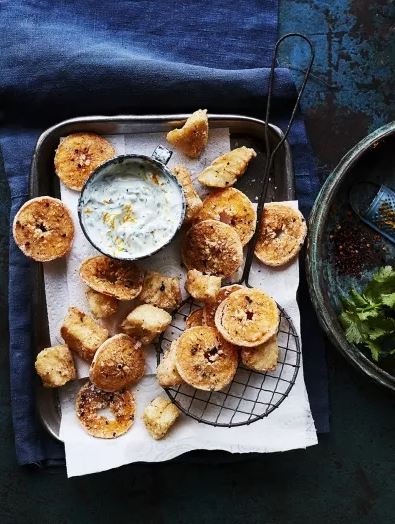
Ingredients 400 gr. white fish fillets 2 limes 1 teaspoon dried chipotle flakes , plus extra to serve 1 teaspoon ground coriander 150 gr. cornflour 150 ml milk 1 litre vegetable oil , for frying 2 clementines Dip 15 gr. fresh coriander 75 gr. plain yoghurt 1 small clove of garlic ½ a clementine Method Cut the fish into 2.5 cm chunks, season with sea salt and black pepper, squeeze over the juice of 1 lime and set aside for 10'. Pick and finely chop most of the fresh coriander leaves for the dip, reserving some for a garnish, and stir through the yoghurt in a small bowl. Peel and crush the garlic, and add to the yoghurt along with the zest of the clementine half. Season to taste and set aside. Crush the chipotle flakes using a pestle and mortar. Transfer to a large, shallow dish with the ground coriander, cornflour and a pinch of salt, then mix well. Pour the milk into a separate bowl. Pour the oil into a large, thick-bottomed saucepan to a depth of around 6cm, it should be no more than two-thirds full. Heat it to 170 ºC, if you don’t have a thermometer, dip the end of a wooden spoon in the oil, if it starts bubbling rapidly around the spoon, it’s ready. Slice the clementines as thinly as you can, about 1 mm. This can be fiddly, so don’t worry about getting perfect rounds. Pat the fish and clementine slices with kitchen paper to soak up any excess juice. Coat them in the cornflour, then dip briefly in the milk before coating again in flour, shaking off the excess. Deep fry the fish and clementine in batches for 2 - 3', or until golden. Drain on kitchen paper and scatter with salt, chipotle and the reserved coriander. Serve immediately with the dip and the remaining lime cut into wedges. Source: https://www.jamieoliver.com/

Ingredients Flatbreads 350 gr. self-raising flour , plus extra for dusting 1 teaspoon baking powder 350 gr. natural yoghurt Garlic and herb butter (optional) 2 cloves of garlic a bunch of fresh soft herbs, such as flat-leaf parsley, tarragon, basil, dill 40 gr. unsalted butter Method Add all the flatbread ingredients to a mixing bowl and mix together with a spoon, then use clean hands to pat and bring everything together. Dust a clean work surface with flour, then tip out the dough. Knead for a minute or so to bring it all together. Put the dough into a floured-dusted bowl and cover with a plate, then leave aside. Garlic butter Peel the garlic cloves and crush them with a garlic crusher. Pick the herb leaves onto a chopping board and finely chop them, discarding the stalks. Melt the butter in a small pan over a medium heat, then stir through the garlic and chopped herbs, then set aside. Dust a clean work surface and rolling pin with flour, then divide the dough in half, then divide each half into 6 equal-sized pieces, roughly the size of a golf ball. With your hands, pat and flatten the dough, then use a rolling pin to roll each piece into 12cm rounds, roughly 2mm to 3mm thick. Use a knife to cut 6 lines into the centre of each round, leaving about 3cm at each end. Place the griddle pan on a high heat, then once hot, cook each one for 1 - 2' on each side, or until bar-marked and puffed up, turning with tongs. Brush the flatbreads all over with herby garlic butter as they come off the griddle, then pile onto a serving board so everyone can dig in and help themselves. Source: https://www.jamieoliver.com/

Ingredients 2 sprigs of fresh rosemary 100 gr. higher-welfare smoked streaky bacon olive oil 1000 gr. quality minced beef 1000 gr. higher-welfare minced pork 4 carrots 2 onions 4 sticks of celery 2 heaped tablespoons tomato purée 1600 gr. plum tomatoes 350 gr. dried lasagne sheets White sauce 150 gr. mature Cheddar cheese 2 medium leeks 2 fresh bay leaves 4 tablespoons plain flour 1 litre semi-skimmed milk 1 whole nutmeg , for grating Method Strip and finely chop the rosemary leaves and finely chop the bacon. Heat 1 tablespoon of oil in a large casserole pan on a high heat. Once hot, add the rosemary and bacon and fry for 2', or until the bacon starts to crisp up, stirring regularly. Add all the minced meat, using a wooden spoon to break it up as you go. Reduce the heat to medium and cook for at least 10', or until all the liquid has evaporated, stirring occasionally. Place the coarse grater attachment in your food processor and grate the Cheddar, then tip into a bowl. Replace the grater with the regular blade. Trim and halve the carrots, then add to the processor and blitz to roughly the same size as the mince. Peel and halve the onions, add them to the carrot and blitz again. Tip into the pan with the mince while you get on with blitzing and adding the celery. Cook for 15 - 20', or until the vegetables start to soften, stirring regularly. Next, add the tomato purée and plum tomatoes, breaking them up with a spoon. Fill each of the tins with water and tip into the pan. Give everything a good stir and reduce the heat to low. Leave to simmer around 2 hours, or until thickened and reduced, stirring occasionally. White sauce Trim, wash and finely slice the leeks, then add to a pan along with 2 tablespoons of oil and the bay leaves. Stir well and season with a tiny pinch of sea salt and black pepper. Reduce the heat to low and cook for 30 minutes, or until sweet and softened, adding splashes of water, if needed. Add the flour and stir well to coat, then gradually add the milk, stirring continuously. Turn the heat up to medium, bring to the boil, then reduce to low and cook for 5 - 10', or until thickened, stirring regularly. Carefully transfer the sauce to the food processor and blitz until smooth and silky. Add half the grated cheese and finely grate over half the nutmeg and mix well. Season to taste. Once the ragù is ready, preheat the oven to 190 ºC. Season the ragù to taste, then transfer half into freezer bags, portioning up as appropriate for your family. Allow to cool to room temperature,then pop in the freezer for another day. A good idea is to freeze them flat so that you can reheat them quickly. To build your lasagne, spoon a quarter of the ragù into a large deep ovenproof dish, roughly 25x30 cm, and spread it out evenly. Spoon over a quarter of the white sauce, then snap over some lasagne sheets, making sure they completely cover the sauce in one layer. Repeat this 3 times, finishing with a layer of white sauce. Sprinkle over the remaining cheese and bake the lasagne in the oven for 45' or until golden and bubbling. Remove the lasagne from the oven and leave to sit for 5 - 10' before serving. Source: https://www.jamieoliver.com/

Ingredients 400 gr. Maris Piper potoatoes 250 gr. cauliflower 125 gr. frozen peas 1 onion 2 cloves of garlic 5 cm piece of ginger 1 fresh green chilli 1 teaspoon cumin seeds ½ teaspoon fennel seeds 1 teaspoon garam masala 1 teaspoon ground coriander ½ a lemon 15 gr. fresh coriander Dough 550 gr. plain flour , plus extra for dusting ½ teaspoon baking powder 2 teaspoons ajwain seeds , optional groundnut oil or vegetable oil Method Dough Combine the flour, baking powder, a good pinch of sea salt and the ajwain seeds, if using, in a large bowl. Use your fingers to rub in 120ml of oil until the mixture resembles breadcrumbs. Stir in 150ml of cold water, then bring it together with your hands into a rough dough, adding a splash more water, if needed. Place in a flour-dusted bowl, cover with a damp tea towel and leave to rest for 30'. Filling Peel and chop the potatoes into rough 2.5cm chunks, then break the cauliflower into florets so they’re roughly the same size. Add the potatoes to a large pan of boiling salted water and cook for 10 to 12', or until tender, adding the cauliflower after 3'. Add the peas for the final minute, then drain. Peel and finely chop the onion and garlic, then peel and finely grate the ginger. Deseed and finely chop the chilli. Drizzle a lug of oil into a large non-stick frying pan over a medium heat, add the cumin and onion and cook for 8', or until softened but not coloured. Stir in the garlic, ginger and chilli, then fry for a further few minutes. Bash the fennel seeds to a fine powder and add to the pan along with the garam masala and ground coriander, stir well. Stir the cooked veg into the pan and crush gently with a potato masher, don't overdo it, you want a fairly chunky mixture. Squeeze in the lemon juice and season to taste. Leave to cool, then pick, finely chop and stir in the coriander leaves. Samosas Preheat the oven to 180 ºC. Lightly grease a large baking tray with oil. On a flour-dusted surface, halve the dough and roll out each portion to about 3cm thick. Using a 7cm pastry cutter, stamp out as many circles as you can, then roll into rounds, roughly ½cm thick and 18cm in diameter. Cut each round in half, then brush the straight edges with a little water. Roll into a cone shape, bringing the straight edges together and pressing lightly to seal. Spoon in the filling, brush the exposed dough with a little water, then fold over and press to seal. Place onto the prepared baking tray, then repeat with the remaining ingredients, keeping the samosas covered with a damp tea towel as you go. Brush the samosas with a little oil and bake for 45', or until golden and piping hot through. Serve straightaway with mango chutney. Source: https://www.jamieoliver.com/

Ingredients 500 gr. plain flour , plus extra for dusting 1 tbsp baking powder 125 ml groundnut oil , plus extra for frying 2 cloves of garlic , finely sliced 2 onions , finely chopped 1 tsp cumin 800gr. tins of kidney beans , drained 2 tbsp sour cream a splash of white wine vinegar 1–2 red chillies , deseeded and finely chopped, to serve 1 bunch of coriander , finely chopped to serve lime wedges , to serve Topping options 220 gr. chorizo , sliced and fried 150 gr. Cheddar cheese , coarsely grated 150 gr. Feta cheese , broken into chunks 2 - 4 avocados , sliced and dressed with lime juice 4 - 6 large free-range eggs , fried chilli sauce Method Sift the flour, baking powder and 2 teaspoons of salt together in a bowl and make a well in the centre. Pour in the groundnut oil and about 200 ml of warm water, or as much as you need to form a dough, mixing with a knife until it comes together. Tip the dough onto a floured work surface and knead for 4 - 5', until smooth and elastic, then return it to the bowl, cover with a tea towel and leave to prove for 1 hour. Place a large non-stick frying pan over a low–medium heat and pour in a glug of the oil. Add the garlic, onions and cumin and sauté for about 10', until soft and sticky. Turn up the heat to medium, stir in the kidney beans, sour cream and vinegar, season well and simmer for about 5', until the beans have softened. Mash your refried beans for a coarse texture, or blitz them in a blender if you prefer them smooth. Return the beans to the pan and leave to one side for reheating later. When your dough has risen, divide it into 12 even pieces and roll them into balls. Flatten out each one with your hand, then, on a floured surface, roll them out into a tortilla 2mm thick and about 18cm in diameter. Place a large non-stick frying pan over a medium heat and, once hot, dry-fry each tortilla for 1' on each side, until just coloured Cover with warm tortillas with kitchen foil while you fry the rest. When you're ready to serve, lay out your chosen toppings. Place the pan of bean mixture over a low-medium heat for 1 - 2', until warmed through, then spread a couple of spoonfuls over each tortilla. Scatter over the chilli and coriander, add your toppings and serve with lime wedges on the side, for squeezing over. Source: https://www.jamieoliver.com/

Ingredients 400 gr. durum wheat flour , or fine semolina flour, plus extra for dusting olive oil 1 dried red chilli 1 dried red pepper 1 teaspoon sweet paprika 15 gr. fresh thyme 125 gr. large higher-welfare quality spicy sausage 1 red onion 2 cloves of garlic 125 ml southern Italian white wine 400 gr. tin of quality plum tomatoes 40 gr. pecorino , or Parmesan cheese Method Pile the flour on to a clean surface and make a well in the middle. Gradually add 200 ml of warm water, using a fork to bring the flour in from the outside until it forms a dough. Knead on a flour-dusted surface for 10', or until smooth and elastic. Cut the dough into four so you can work with it a quarter at a time. Cover the rest with a clean damp tea towel while you work, to stop it drying out. Roll your first quarter into a long sausage shape about 1cm in diameter, then cut it into 2 cm chunks. Lightly flour the back of a fine grater, gently squash a chunk of dough against it with your thumb and roll it off to create a nubbly,textured shape. Place on a semolina-dusted tray and repeat – you’ll get the knack. Place a large frying pan on a medium heat with 3 tablespoons of oil. Remove the stalks and seeds from the chilli and pepper, tear into flakes and add to the pan. Strip in the thyme leaves and fry for 30", or until crisp, then spoon out and save for later, leaving the pan on the heat. Squeeze the sausagemeat out of the skin into the pan and mash it up. Peel, finely chop and add the onion and garlic, and the paprika, if using,, then fry gently for 15', or until soft, stirring occasionally. Add the wine, cook away, then mash in the tomatoes. Season and simmer for 15'. Cook the pasta in a pan of boiling salted water for 4', or until tender, then drain, reserving a mugful of starchy cooking water. Toss with the sauce, finely grate over most of the pecorino and toss again, loosening with a splash of reserved cooking water, if needed. Sprinkle over the chilli pepper mix and finely grate over the remaining pecorino, to finish. Source: https://www.jamieoliver.com/

Igredients 1 knob butter 100 gr. polenta 200 gr. plain flour , sifted 100 gr. stale breadcrumbs 100 gr. caster sugar , plus extra for dusting 500 ml full-fat milk 3 large free-range eggs , beaten 100 gr. runny honey 55 ml olive oil 100 gr. dried figs , chopped or torn up 100 gr. raisins or sultanas 500 gr. firm eating apples , peeled, cored and roughly diced ½ teaspoon ground cinnamon 2 oranges , zest of 2 lemons , zest of 1 teaspoon salt Method Preheat the oven to 180 ºC and butter a shallow 28 cm loose-bottomed cake tin. Mix the polenta, flour, breadcrumbs and sugar in a large bowl. In a separate bowl, mix together the milk, eggs, honey and olive oil. Add the wet mixture to the dry mixture, making sure you stir it all together well. Add the figs, raisins, apples, cinnamon, orange and lemon zest and salt, and stir again. Pour the mixture into your cake tin and bake for about 50'. Keep an eye on it, you may need to cover it with some foil if you find that it starts to brown too much at the edges. Before serving, sprinkle over some caster sugar and make sure you eat it warm. Source: https://www.jamieoliver.com/
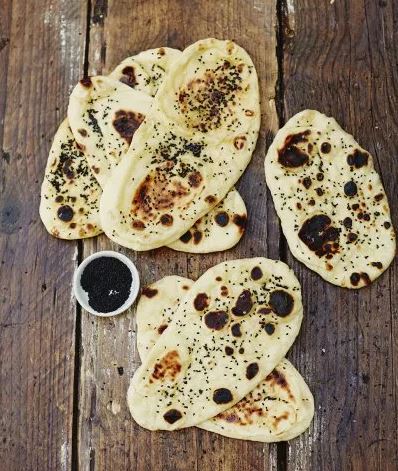
Ingredients 3.5 gr. dried yeast 1 teaspoon runny honey 45 gr. ghee , or unsalted butter 250 gr. strong white bread flour , plus extra for dusting 3 heaped tablespoons low-fat natural yoghurt 1 tablespoon nigella seeds Method Combine the yeast, honey and 125 ml of lukewarm water in a bowl, then set aside for 5', or until starting to bubble. Melt the ghee in a small pan over a low heat. Meanwhile, combine the flour and ½ tablespoon of sea salt in a large bowl and make a well in the middle. Pour 1 tablespoon of the melted ghee into the well, followed by the yoghurt and yeast mixture, then beat the wet ingredients together with a fork. Gradually start incorporating the flour from the sides until it starts to form a rough dough, then bring it together with your hands, it should be soft and sticky, so add a splash more water, if you think it needs it. Knead the dough on a flour-dusted surface for around 5', or until smooth, then place into a lightly floured bowl. Cover with a clean tea towel and leave in a warm place for 90', or until doubled in size. Once risen, knock back the dough with your fist, then divide into 6 balls. Roll each portion into an oval shape, roughly 1½cm thick. Heat a large non-stick frying pan over a high heat, add a naan bread and cook for 5 - 6', or until cooked through, turning halfway. Brush with a little of the remaining ghee, sprinkle over a few nigella seeds and a small pinch of salt. Keep warm in the oven while you make the remaining breads. Source: https://www.jamieoliver.com/

Ingredients 40 gr. candied peel 50 gr. glacé cherries 1 orange 100 gr. raisins, sultanas and currants 25 gr. dried cranberries 2 tablespoons brandy or dried rum 3-4 cardamom pods 7 gr. dried active yeast 25 gr. sugar 125 ml whole milk , plus a little extra 275 gr. strong white bread flour , plus extra for dusting ½ teaspoon mixed spice 50 gr. unsalted butter at room temperature 1 medium free-range egg 1 teaspoon vanilla extract 25 gr. almonds 25 gr. shelled pistachios 225 gr. marzipan olive oil , or vegetable oil, for greasing icing sugar , for dusting Method Finely chop the candied peel, and quarter the glacé cherries and finely grate the orange zest. Place all of the dried fruit into a bowl with the orange zest. Squeeze the orange juice into a pan, add the brandy or rum and heat to just below boiling point, then pour it over the dried fruit. Mix well, then set aside for 1 - 2 hours to allow it to plump up. Dough Remove the seeds from the cardamom pods, then grind to a powder in a pestle and mortar, roughly ¼ of a teaspoon. Spoon the yeast into the bowl of a free-standing mixer, then add the sugar. In a pan, heat the milk until just warm, add to the yeast and whisk to combine. Set aside for 5 - 10', until the yeast has formed a thick, foamy crust on the milk. Add the flour, spices and ½ teaspoon of sea salt. Using a dough hook, combine the butter, egg and vanilla, then mix for 5', until smooth and elastic. Cover the bowl with clingfilm and leave in a warm place until the dough has doubled in size, about 1 hour. Line a baking sheet with baking paper and set aside. Roughly chop the almonds and pistachios. Pour away about half the liquid from the soaked fruit, then add the fruit and remaining liquid to the dough, along with the nuts, mix again. Turn the dough out onto a lightly floured surface and knead lightly for 1'. Shape the dough into an oval shape, about A4 size. Roll the marzipan into a neat log, about 4cm shorter than the length of the dough, and place in the middle of the oval. Brush one long edge of the dough with milk and fold it over, completely encasing the marzipan, and press the edges together to seal. Carefully lift the dough onto the baking sheet, cover loosely with oiled clingfilm and leave to rise for 45 - 60', until nearly doubled in size. Preheat the oven to 180 ºC. Remove the clingfilm, then bake the stollen for 30', or until golden, risen and the underside sounds slightly hollow when tapped. Leave to cool on a wire rack before dredging with icing sugar to serve. Source: https://www.jamieoliver.com/

Ingredients cream , optional, to serve custard , optional, to serve Pastry 500 gr. plain flour, plus extra for dusting 100 gr. icing sugar 250 gr. unsalted butter, chilled and cut into cubes 2 large free-range eggs 1 splash milk Filling 10 Granny Smith apples , peeled, cored and halved, 3 sliced 2 oranges , juice and zest of 7 heaped tablespoons caster sugar 400 gr. huckleberries or blueberries 1 heaped tablespoon plain flour 1 large free-range egg , beaten 1 small handful demerara sugar good-quality vanilla ice cream , optional, to serve Method You can make your pastry by hand, or simply pulse all the ingredients in a food processor. If making by hand, sieve the flour, icing sugar and a pinch of sea salt from a height into a large mixing bowl. Use your fingertips to gently work the cubes of butter into the flour and sugar until the mixture resembles breadcrumbs. Transfer a handful of this mixture to a separate bowl, rub it between your fingers to get larger crumbs, then put aside. Add the eggs and milk to the main mixture and gently work it together until you have a ball of pastry dough. Don’t work it too much at this stage, you want to keep it crumbly and short. Sprinkle a little flour over the pastry, then wrap it in cling film and pop it into the fridge to rest for 1 hour. Meanwhile Put the apples into a large pan with the zest and juice of 1 orange, a splash of water and 5 tablespoons of caster sugar. Cover the pan and simmer on a medium heat for 10 minutes, until the apples have softened but still hold their shape. Remove from the heat and leave to cool. Scrunch a handful of berries in a bowl with the remaining caster sugar and the zest and juice of your remaining orange. Add the rest of the berries. Toss the cooled apples and their juices in a large bowl with the berries and the flour, then put aside. Preheat your oven to 180 ºC. Take your ball of pastry out of the fridge and let it come up to room temperature. Get yourself a pie dish around 28 cm in diameter. Flour a clean surface and a rolling pin. Cut off a third of your pastry and put that piece to one side. Roll the rest into a circle just over 0.5cm thick, dusting with flour as you go. Roll the circle of pastry up over your rolling pin, then gently unroll it over the pie dish. Push it into the sides, letting any excess pastry hang over the edge. Tip in the fruit filling and brush all around the edge of the pastry with some of the beaten egg. Roll out the smaller ball of pastry about 0.5cm thick and use your rolling pin to lay it over the top of the pie. Brush it all over with more beaten egg, reserving a little. Sprinkle over the reserved crumble mixture and the demerara sugar. Fold the scruffy edges of pastry hanging over the sides back over the pie, sealing the edge by twisting or crimping it as you like. Brush these folded edges with your remaining beaten egg. Using a small, sharp knife, cut a cross into the middle of the pie. Place on the bottom of the oven and bake for 45 - 55', until golden and beautiful. Source: https://www.jamieoliver.com/