


Suggested Receipes with: Calves

Ingredients 2 sprigs of fresh rosemary 100 gr. higher-welfare smoked streaky bacon olive oil 1000 gr. quality minced beef 1000 gr. higher-welfare minced pork 4 carrots 2 onions 4 sticks of celery 2 heaped tablespoons tomato purée 1600 gr. plum tomatoes 350 gr. dried lasagne sheets White sauce 150 gr. mature Cheddar cheese 2 medium leeks 2 fresh bay leaves 4 tablespoons plain flour 1 litre semi-skimmed milk 1 whole nutmeg , for grating Method Strip and finely chop the rosemary leaves and finely chop the bacon. Heat 1 tablespoon of oil in a large casserole pan on a high heat. Once hot, add the rosemary and bacon and fry for 2', or until the bacon starts to crisp up, stirring regularly. Add all the minced meat, using a wooden spoon to break it up as you go. Reduce the heat to medium and cook for at least 10', or until all the liquid has evaporated, stirring occasionally. Place the coarse grater attachment in your food processor and grate the Cheddar, then tip into a bowl. Replace the grater with the regular blade. Trim and halve the carrots, then add to the processor and blitz to roughly the same size as the mince. Peel and halve the onions, add them to the carrot and blitz again. Tip into the pan with the mince while you get on with blitzing and adding the celery. Cook for 15 - 20', or until the vegetables start to soften, stirring regularly. Next, add the tomato purée and plum tomatoes, breaking them up with a spoon. Fill each of the tins with water and tip into the pan. Give everything a good stir and reduce the heat to low. Leave to simmer around 2 hours, or until thickened and reduced, stirring occasionally. White sauce Trim, wash and finely slice the leeks, then add to a pan along with 2 tablespoons of oil and the bay leaves. Stir well and season with a tiny pinch of sea salt and black pepper. Reduce the heat to low and cook for 30 minutes, or until sweet and softened, adding splashes of water, if needed. Add the flour and stir well to coat, then gradually add the milk, stirring continuously. Turn the heat up to medium, bring to the boil, then reduce to low and cook for 5 - 10', or until thickened, stirring regularly. Carefully transfer the sauce to the food processor and blitz until smooth and silky. Add half the grated cheese and finely grate over half the nutmeg and mix well. Season to taste. Once the ragù is ready, preheat the oven to 190 ºC. Season the ragù to taste, then transfer half into freezer bags, portioning up as appropriate for your family. Allow to cool to room temperature,then pop in the freezer for another day. A good idea is to freeze them flat so that you can reheat them quickly. To build your lasagne, spoon a quarter of the ragù into a large deep ovenproof dish, roughly 25x30 cm, and spread it out evenly. Spoon over a quarter of the white sauce, then snap over some lasagne sheets, making sure they completely cover the sauce in one layer. Repeat this 3 times, finishing with a layer of white sauce. Sprinkle over the remaining cheese and bake the lasagne in the oven for 45' or until golden and bubbling. Remove the lasagne from the oven and leave to sit for 5 - 10' before serving. Source: https://www.jamieoliver.com/
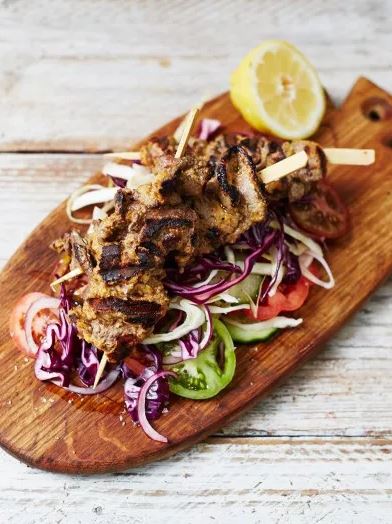
Ingredients 1000 gr. fillet of beef , trimmed 500 gr. ripe tomatoes , mixed colours if possible ½ a red cabbage ½ a white cabbage 1 red onion 1 cucumber 2 lemons extra virgin olive oil sea salt and freshly ground black pepper olive oil For the marinade 10 uda pods 400 gr. salted roasted peanuts 1 teaspoon freshly ground black pepper 1 teaspoon onion granules 1 teaspoon garlic granules 1 teaspoon ground ginger 1 teaspoon freshly ground white pepper 1 teaspoon paprika 1 teaspoon chilli powder 1 teaspoon cayenne pepper 1 organic fish or chicken stock cube 1 onion 4 cloves of garlic 1 thumb-sized piece of ginger 1 fresh green chilli 1 fresh Scotch bonnet 1 green pepper 1 spring onion Method Around 1 hour before you start, soak 32 wooden skewers in plenty of cold water. Very finely slice the beef, flatten slightly with the flat side of your knife, then place on a plate. Cover and place in the fridge until needed. Marinade Bash the uda pods in a pestle and mortar. Remove and discard the seeds, then place the pods into a liquidiser with the peanuts and spices. Crumble in the stock cube, then blitz for 5 - 10' to a rough powder, stopping and stirring the mixture from time to time. Transfer the ground spices to a large bowl. Peel and roughly chop the onion, garlic and ginger. Trim and deseed the chillies and pepper, then roughly chop. Trim and roughly chop the spring onion. Add it all to the liquidiser and blitz until smooth. Transfer the mixture to the ground spices and stir well. Turn the beef in the marinade until well coated, then thread 4 to 5 slices onto each soaked skewer. Place on a tray, cover and pop in the fridge to marinate for around 3 hours. Salad Finely slice the tomatoes, then trim and finely shred the cabbage. Peel and finely slice the onion, then finely slice the cucumber. Place into a large bowl with a squeeze of lemon juice, a drizzle of extra virgin olive oil and a pinch of salt and pepper. Preheat a large griddle pan over a medium-high heat. Drizzle the skewers with a little olive oil, then place on the griddle for 1 - 2', or until beautifully gnarly and golden, turning regularly. Drizzle over a little extra virgin olive oil, then serve with the salad and extra lemon wedges for squeezing over. Tip Uda pods add a lovely sharp, peppery taste to dishes and are used a lot in West African cooking. If you can’t get hold of them, Szechuan peppercorns are similar in flavour. Source: https://www.jamieoliver.com/

Ingredients 600 gr. piece of rib-eye steak, ideally 5 cm thick, fat removed 4 sprigs of fresh rosemary 4 cloves of garlic 350 gr. mixed mushrooms 600 gr. quality white beans Method Place a large non-stick frying pan on a medium-high heat. Rub the steak all over with a pinch of sea salt and black pepper, then sear on all sides for 10' in total, so you achieve good colour on the outside but keep it medium rare in the middle, or cook to your liking, turning regularly with tongs. Meanwhile, strip the rosemary leaves off the sprigs, peel and finely slice the garlic, and tear up any larger mushrooms. When the steak’s done, remove to a plate and cover with tin foil. Reduce the heat under the pan to medium, and crisp up the rosemary for 30", then add the garlic and mushrooms and cook for 8', or until golden, tossing regularly. Pour in the beans and their juice, add 1 tablespoon of red wine vinegar and simmer for 5', then season to perfection. Sit the steak on top and pour over any resting juices. Slice and serve at the table, finishing with a little extra virgin olive oil, if you like. Source: https://www.jamieoliver.com/
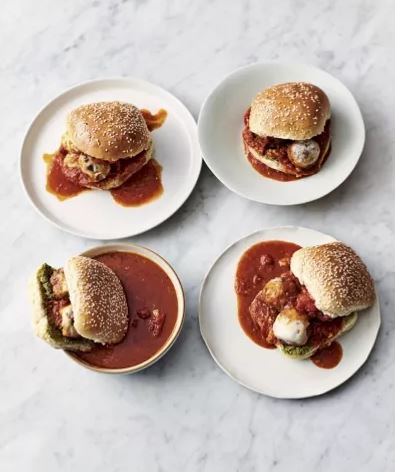
Ingredients 400 gr. lean minced beef 8 heaped teaspoons green pesto 400 gr. tin of plum tomatoes 125 gr. ball of mozzarella 4 soft burger buns Method Use your clean hands to scrunch the minced beef with half the pesto and a pinch of sea salt and black pepper. Split into 12 pieces and, with wet hands, roll into balls. Brown the balls all over in a non-stick frying pan on a high heat with 1 tablespoon of olive oil, shaking the pan regularly. Once the balls are golden & gnarly, pour in the tomatoes, breaking them up with a wooden spoon, along with a quarter of a tin’s worth of water. Bring to the boil, slice the mozzarella and lay over the balls, pop the lid on and leave to thicken for 5' on a medium heat. Meanwhile, warm your buns in a large dry non-stick frying pan or in the oven on a low heat. Split each bun and spread 1 heaped teaspoon of pesto inside. Divvy up the balls and mozzarella with a little sauce, serving the rest on the side for dunking. Source: https://www.jamieoliver.com/
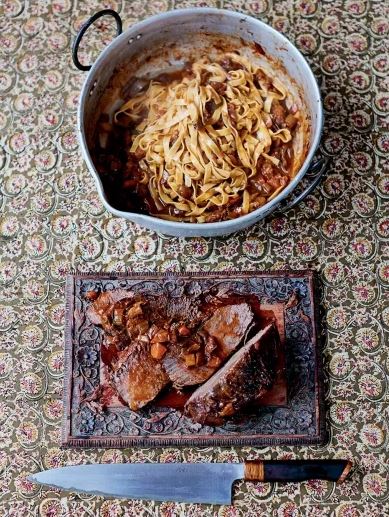
Ingredients 1000 gr. piece of beef chuck , sinew removed olive oil 2 red onions 2 carrots 2 cloves of garlic 2 sticks of celery 1 bulb of fennel 15 gr. fresh rosemary 15 gr. fresh sage 250 ml Chianti red wine 2 tablespoons tomato purée 1.5 litres organic meat or veg stock Method Place the meat in a fairly snug-fitting casserole pan on a medium-low heat with 2 tablespoons of oil, turning with tongs, while you peel the onions, carrots and garlic, trim the celery and fennel, then roughly chop it all to make a soffritto. Stir into the pan, tie the rosemary and sage together and add, then season with sea salt and black pepper. Cook for 20 - 30', or until starting to caramelize, stirring the veg and turning the meat occasionally. Turn the heat up to high, pour in the wine, stir in the tomato purée, and let the wine cook away. Pour in the stock, bring to the boil, then place a double layer of scrunched-up wet greaseproof paper on the surface. Reduce to a low heat and cook for around 3 hours, or until the meat is meltingly tender, turning and basting occasionally. Season to perfection. Lift the meat out on to a board, carve it into thin slices, and spoon over enough of that incredible sauce to keep the meat nice and juicy. Toss the rest of the sauce, reduce on the hob if needed, with freshly cooked tagliatelle, and finely grate over a little Parmesan, to serve. Source: https://www.jamieoliver.com/

Ingredients 200 gr. dairy-free dark chocolate, at least 75% cocoa solids 700 gr. silken tofu 160 gr. maple syrup zest of 1 lime 1 tablespoon vanilla bean paste 1 tablespoon dark rum 1 large pinch of dried chilli flakes 1 large pinch of sea salt Method Place a small pan over a medium-low heat, half-fill with boiling water, then place a medium heatproof bowl on top, making sure the base doesn’t touch the surface of the water. Break in the chocolate, then allow to melt, stirring occasionally. Meanwhile, line a medium bowl with a clean tea towel. Add the tofu, bunch up the tea towel and squeeze out the excess moisture into the bowl. Add the tofu to a food processor with the remaining ingredients and 1 good pinch of sea salt, then blitz for 1 - 2', or until smooth. Add the melted chocolate and pulse until silky and combined. Divide the mixture between little bowls, to make it extra special, I like to use a mixture of espresso cups and cute little glasses. Pop in the fridge for 15' to chill, then serve. Source: https://www.jamieoliver.com/

Ingredients Pastry 150 gr. plain flour 40 gr. cocoa 25 gr. icing sugar 120 gr. unsalted butter 1 large free-range egg yolk Filling 300 gr. caster sugar 60 ml runny honey 300 ml double cream 45 gr. unsalted butter Nut brittle 50 gr. blanched hazelnuts 100 gr. caster sugar Spun sugar 100 gr. caster sugar 1/2 tablespoon glucose syrup Method Pastry Sift the flour, cocoa and icing sugar into a bowl. Rub in the butter until it resembles fine breadcrumbs and stir in a pinch of sea salt. Stir in the egg yolk and 45 ml water, then bring together into a dough, add more flour if necessary. Wrap in clingfilm and leave to rest in the fridge for 30'. Preheat the oven to 190 ºC. Line a 25 cm fluted tart tin with the pastry, pressing into the sides. Line with baking paper and fill with baking beads or rice. Set on a baking sheet and rest in the fridge for 30'. Transfer the tin to the oven on the baking sheet for 15'. Roast the nuts for the brittle at the same time, until they are a golden brown. Remove the baking paper and beads or rice. Return the pastry to the oven for 5', or until the base has cooked through. Filling Place the sugar and honey into a pan and set over a medium heat. Once the sugar begins to melt, swirl in circular motions to start the caramel until it’s golden. Remove from the heat, whisk in the cream and butter. Place back onto the heat and whisk until the caramel turns golden brown. Remove and pour into the tart case, then set aside. Nut brittle Line a baking tray with baking paper. Put the sugar in a pan with the thermometer and set over a medium heat. Have your roasted hazelnuts ready. When the sugar starts to gently bubble at the edges, tilt the pan to ensure the sugar melts evenly. Before long, about 3', all of it will be melted. When it gets to 150 ºC, remove the pan from the heat and swirl in the hazelnuts, do not stir with a spoon. Quickly pour it onto the tray and leave to aside. When the nut brittle is cool, chop or blitz in a processor to small pieces. Sprinkle the pieces of brittle over the top of the finished tart. To decorate with spun sugar, heat the sugar and glucose with 50ml water in the same pan, over a medium heat. Allow the sugar to melt, stir for even texture. Heat for 8 - 10', until 150 ºC, then remove and quickly place into an ice bath to stop the process and set aside. Take two forks and pull the sugar out, twirling the forks to make long strands into nests. Alternatively, place a piece of baking paper on your countertop. While holding a long metal spoon with one hand over the paper, pull the sugar from the pan and quickly flick it back and forth over the long spoon, allowing the sugar to form long thin strands, which you can gather. Use these to decorate the top of the tart. Source: https://www.jamieoliver.com/
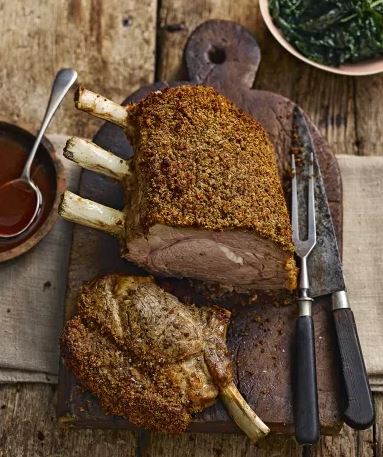
Ingredients 2500 gr. 4-bone higher-welfare veal rack , trimmed of most of its fat and bones cleaned olive oil 2 tablespoons Dijon mustard 5 gr. dried porcini 50 gr. wholemeal bread 70 gr. vacuum packed chestnuts 3 sprigs of fresh sage Cumberland sauce 1 orange 4 tablespoons port 4 tablespoons redcurrant jelly 1 teaspoon English mustard Method Preheat the oven to 180 ºC. Remove the veal rack from the fridge and allow to come up to room temperature. Place a large frying pan over a high heat. Rub the veal all over with oil and a pinch each of sea salt and black pepper. Place it in the pan and sear all over for 3 - 4', until golden brown. Transfer the veal to the baking tray and brush the top with the mustard. Place the porcini in a small bowl, cover with boiling water and leave for a couple of minutes for the mushrooms to rehydrate and soften. Pick the sage leaves. In a food processor, add the porcini, bread, chestnuts, sage, a pinch of salt and pepper and a decent splash of oil. Pulse until it all comes together to form a coarse paste. Spoon the chestnut crust onto the veal and pat it down firmly. Place the rack in the oven for 70 - 80'. Remove from the oven and leave to rest for at least 30'. While the veal is resting, make the sauce. Squeeze the orange juice into a saucepan and combine with the remaining ingredients, plus any cooking juices from the veal pan. Place over a low heat, stirring, until smooth and combined. Season the sauce to taste and serve with the veal rack and some steamed winter greens. Source: https://www.jamieoliver.com/

Ingredients 500 gr. piece of fillet steak 300 gr. radishes , ideally with leaves 1 pomegranate 40 gr. preserved lemons 1 heaped tablespoon dukkah Method Rub the steak all over with ½ a tablespoon of olive oil and a pinch of sea salt and black pepper. Get a non-stick frying pan hot on a high heat, then sear the steak on all sides for 3' in total. Remove to a board. Finely slice the radishes, reserving any nice leaves. Halve the pomegranate and holding one half cut side down in your fingers, bash the back of it with a spoon so all the seeds tumble out into a bowl. Squeeze the juice from the remaining half through a sieve into a separate bowl. Quarter the preserved lemons and trim away the seedy core. Finely chop the rind and add to the pomegranate juice with 1 tablespoon each of extra virgin olive oil and red wine vinegar, then taste and season to perfection. Slice the steak as finely as you can, then use the side of your knife to flatten and stretch out each slice. Divide between your plates, sprinkle over the radishes and leaves, then spoon over the dressing. Scatter over the dukkah and pomegranate seeds, then finish with a drizzle of extra virgin olive oil. Source: https://www.jamieoliver.com/
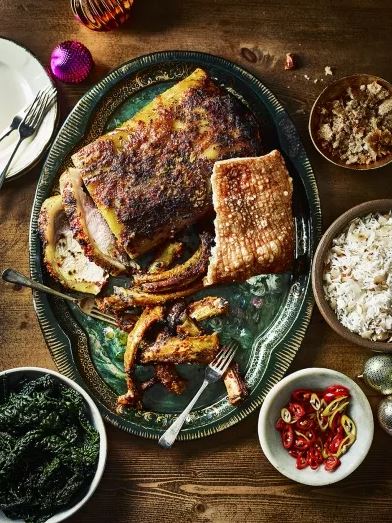
Ingredients 2 bulbs of garlic 80 gr. piece of ginger 6 mixed-colour chillies 2 tablespoons ground turmeric 3000 gr. higher-welfare rib-end of pork loin , ribs and skin removed and reserved Pantry olive oil 3 tablespoons red wine vinegar Method Preheat the oven to full whack 240 ºC. Peel the garlic and ginger, deseed 3 chillies, roughly chop it all, then place in a pestle and mortar with a pinch of sea salt and pound to a thick paste. Muddle in the turmeric and 1 tablespoon of oil, then, in a large roasting tray, rub the paste all over the pork loin and the ribs. Season the pork skin and place directly on the bars of the oven, sitting the tray of pork underneath to catch the fat that drips out. Reduce the oven to 180 ºC and cook for 45', removing the crackling after 20', or once it’s puffed up and golden. Meanwhile, slice the remaining chillies and place in a bowl with a little salt, add the vinegar and set aside to lightly pickle. Remove the pork tray from the oven. Transfer the loin and ribs to a board, cover with tin foil and leave to rest. Pour 100 ml of water into the roasting tray, place on a medium heat on the hob, and simmer for 5', or until reduced by half. Smash up half the crackling into a dust for sprinkling, leaving the rest more chunky. Slice the pork loin and serve with the ribs, pan juices, crackling dust and pickled chillies. Source: https://www.jamieoliver.com/