


Suggested Receipes with: Milk
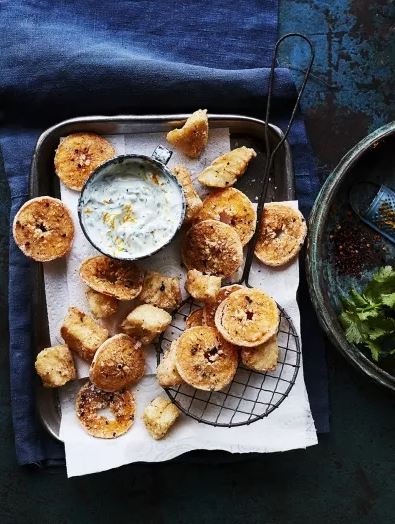
Ingredients 400 gr. white fish fillets 2 limes 1 teaspoon dried chipotle flakes , plus extra to serve 1 teaspoon ground coriander 150 gr. cornflour 150 ml milk 1 litre vegetable oil , for frying 2 clementines Dip 15 gr. fresh coriander 75 gr. plain yoghurt 1 small clove of garlic ½ a clementine Method Cut the fish into 2.5 cm chunks, season with sea salt and black pepper, squeeze over the juice of 1 lime and set aside for 10'. Pick and finely chop most of the fresh coriander leaves for the dip, reserving some for a garnish, and stir through the yoghurt in a small bowl. Peel and crush the garlic, and add to the yoghurt along with the zest of the clementine half. Season to taste and set aside. Crush the chipotle flakes using a pestle and mortar. Transfer to a large, shallow dish with the ground coriander, cornflour and a pinch of salt, then mix well. Pour the milk into a separate bowl. Pour the oil into a large, thick-bottomed saucepan to a depth of around 6cm, it should be no more than two-thirds full. Heat it to 170 ºC, if you don’t have a thermometer, dip the end of a wooden spoon in the oil, if it starts bubbling rapidly around the spoon, it’s ready. Slice the clementines as thinly as you can, about 1 mm. This can be fiddly, so don’t worry about getting perfect rounds. Pat the fish and clementine slices with kitchen paper to soak up any excess juice. Coat them in the cornflour, then dip briefly in the milk before coating again in flour, shaking off the excess. Deep fry the fish and clementine in batches for 2 - 3', or until golden. Drain on kitchen paper and scatter with salt, chipotle and the reserved coriander. Serve immediately with the dip and the remaining lime cut into wedges. Source: https://www.jamieoliver.com/

Ingredients 2 sprigs of fresh rosemary 100 gr. higher-welfare smoked streaky bacon olive oil 1000 gr. quality minced beef 1000 gr. higher-welfare minced pork 4 carrots 2 onions 4 sticks of celery 2 heaped tablespoons tomato purée 1600 gr. plum tomatoes 350 gr. dried lasagne sheets White sauce 150 gr. mature Cheddar cheese 2 medium leeks 2 fresh bay leaves 4 tablespoons plain flour 1 litre semi-skimmed milk 1 whole nutmeg , for grating Method Strip and finely chop the rosemary leaves and finely chop the bacon. Heat 1 tablespoon of oil in a large casserole pan on a high heat. Once hot, add the rosemary and bacon and fry for 2', or until the bacon starts to crisp up, stirring regularly. Add all the minced meat, using a wooden spoon to break it up as you go. Reduce the heat to medium and cook for at least 10', or until all the liquid has evaporated, stirring occasionally. Place the coarse grater attachment in your food processor and grate the Cheddar, then tip into a bowl. Replace the grater with the regular blade. Trim and halve the carrots, then add to the processor and blitz to roughly the same size as the mince. Peel and halve the onions, add them to the carrot and blitz again. Tip into the pan with the mince while you get on with blitzing and adding the celery. Cook for 15 - 20', or until the vegetables start to soften, stirring regularly. Next, add the tomato purée and plum tomatoes, breaking them up with a spoon. Fill each of the tins with water and tip into the pan. Give everything a good stir and reduce the heat to low. Leave to simmer around 2 hours, or until thickened and reduced, stirring occasionally. White sauce Trim, wash and finely slice the leeks, then add to a pan along with 2 tablespoons of oil and the bay leaves. Stir well and season with a tiny pinch of sea salt and black pepper. Reduce the heat to low and cook for 30 minutes, or until sweet and softened, adding splashes of water, if needed. Add the flour and stir well to coat, then gradually add the milk, stirring continuously. Turn the heat up to medium, bring to the boil, then reduce to low and cook for 5 - 10', or until thickened, stirring regularly. Carefully transfer the sauce to the food processor and blitz until smooth and silky. Add half the grated cheese and finely grate over half the nutmeg and mix well. Season to taste. Once the ragù is ready, preheat the oven to 190 ºC. Season the ragù to taste, then transfer half into freezer bags, portioning up as appropriate for your family. Allow to cool to room temperature,then pop in the freezer for another day. A good idea is to freeze them flat so that you can reheat them quickly. To build your lasagne, spoon a quarter of the ragù into a large deep ovenproof dish, roughly 25x30 cm, and spread it out evenly. Spoon over a quarter of the white sauce, then snap over some lasagne sheets, making sure they completely cover the sauce in one layer. Repeat this 3 times, finishing with a layer of white sauce. Sprinkle over the remaining cheese and bake the lasagne in the oven for 45' or until golden and bubbling. Remove the lasagne from the oven and leave to sit for 5 - 10' before serving. Source: https://www.jamieoliver.com/

Ingredients 400 gr. sushi rice or Thai sticky rice 400 ml tin of coconut milk 100 gr. palm sugar or brown sugar 2 large ripe mangos Method Soak the rice in cold water and leave overnight. The next day, rinse and drain the rice, repeating until the water runs clear. Place it in a pan, cover with cold water and pop on the lid. Bring to a rolling boil, then simmer over a low heat for 5', or until all the water is absorbed. In another pan, stir the coconut milk, sugar and ¼ teaspoon of salt over a medium heat. Bring it to the boil, then take off the heat. Pour half over the rice and leave to absorb for about 2', or until the rice is soft. Pour the rest into a bowl. Chill both in the fridge. Fold the coconut milk through the rice, then peel, destone and cut the mango into wedges. Serve with the sticky rice. Source: https://www.jamieoliver.com/

Igredients 1 knob butter 100 gr. polenta 200 gr. plain flour , sifted 100 gr. stale breadcrumbs 100 gr. caster sugar , plus extra for dusting 500 ml full-fat milk 3 large free-range eggs , beaten 100 gr. runny honey 55 ml olive oil 100 gr. dried figs , chopped or torn up 100 gr. raisins or sultanas 500 gr. firm eating apples , peeled, cored and roughly diced ½ teaspoon ground cinnamon 2 oranges , zest of 2 lemons , zest of 1 teaspoon salt Method Preheat the oven to 180 ºC and butter a shallow 28 cm loose-bottomed cake tin. Mix the polenta, flour, breadcrumbs and sugar in a large bowl. In a separate bowl, mix together the milk, eggs, honey and olive oil. Add the wet mixture to the dry mixture, making sure you stir it all together well. Add the figs, raisins, apples, cinnamon, orange and lemon zest and salt, and stir again. Pour the mixture into your cake tin and bake for about 50'. Keep an eye on it, you may need to cover it with some foil if you find that it starts to brown too much at the edges. Before serving, sprinkle over some caster sugar and make sure you eat it warm. Source: https://www.jamieoliver.com/

Ingredients 40 gr. candied peel 50 gr. glacé cherries 1 orange 100 gr. raisins, sultanas and currants 25 gr. dried cranberries 2 tablespoons brandy or dried rum 3-4 cardamom pods 7 gr. dried active yeast 25 gr. sugar 125 ml whole milk , plus a little extra 275 gr. strong white bread flour , plus extra for dusting ½ teaspoon mixed spice 50 gr. unsalted butter at room temperature 1 medium free-range egg 1 teaspoon vanilla extract 25 gr. almonds 25 gr. shelled pistachios 225 gr. marzipan olive oil , or vegetable oil, for greasing icing sugar , for dusting Method Finely chop the candied peel, and quarter the glacé cherries and finely grate the orange zest. Place all of the dried fruit into a bowl with the orange zest. Squeeze the orange juice into a pan, add the brandy or rum and heat to just below boiling point, then pour it over the dried fruit. Mix well, then set aside for 1 - 2 hours to allow it to plump up. Dough Remove the seeds from the cardamom pods, then grind to a powder in a pestle and mortar, roughly ¼ of a teaspoon. Spoon the yeast into the bowl of a free-standing mixer, then add the sugar. In a pan, heat the milk until just warm, add to the yeast and whisk to combine. Set aside for 5 - 10', until the yeast has formed a thick, foamy crust on the milk. Add the flour, spices and ½ teaspoon of sea salt. Using a dough hook, combine the butter, egg and vanilla, then mix for 5', until smooth and elastic. Cover the bowl with clingfilm and leave in a warm place until the dough has doubled in size, about 1 hour. Line a baking sheet with baking paper and set aside. Roughly chop the almonds and pistachios. Pour away about half the liquid from the soaked fruit, then add the fruit and remaining liquid to the dough, along with the nuts, mix again. Turn the dough out onto a lightly floured surface and knead lightly for 1'. Shape the dough into an oval shape, about A4 size. Roll the marzipan into a neat log, about 4cm shorter than the length of the dough, and place in the middle of the oval. Brush one long edge of the dough with milk and fold it over, completely encasing the marzipan, and press the edges together to seal. Carefully lift the dough onto the baking sheet, cover loosely with oiled clingfilm and leave to rise for 45 - 60', until nearly doubled in size. Preheat the oven to 180 ºC. Remove the clingfilm, then bake the stollen for 30', or until golden, risen and the underside sounds slightly hollow when tapped. Leave to cool on a wire rack before dredging with icing sugar to serve. Source: https://www.jamieoliver.com/

Ingredients cream , optional, to serve custard , optional, to serve Pastry 500 gr. plain flour, plus extra for dusting 100 gr. icing sugar 250 gr. unsalted butter, chilled and cut into cubes 2 large free-range eggs 1 splash milk Filling 10 Granny Smith apples , peeled, cored and halved, 3 sliced 2 oranges , juice and zest of 7 heaped tablespoons caster sugar 400 gr. huckleberries or blueberries 1 heaped tablespoon plain flour 1 large free-range egg , beaten 1 small handful demerara sugar good-quality vanilla ice cream , optional, to serve Method You can make your pastry by hand, or simply pulse all the ingredients in a food processor. If making by hand, sieve the flour, icing sugar and a pinch of sea salt from a height into a large mixing bowl. Use your fingertips to gently work the cubes of butter into the flour and sugar until the mixture resembles breadcrumbs. Transfer a handful of this mixture to a separate bowl, rub it between your fingers to get larger crumbs, then put aside. Add the eggs and milk to the main mixture and gently work it together until you have a ball of pastry dough. Don’t work it too much at this stage, you want to keep it crumbly and short. Sprinkle a little flour over the pastry, then wrap it in cling film and pop it into the fridge to rest for 1 hour. Meanwhile Put the apples into a large pan with the zest and juice of 1 orange, a splash of water and 5 tablespoons of caster sugar. Cover the pan and simmer on a medium heat for 10 minutes, until the apples have softened but still hold their shape. Remove from the heat and leave to cool. Scrunch a handful of berries in a bowl with the remaining caster sugar and the zest and juice of your remaining orange. Add the rest of the berries. Toss the cooled apples and their juices in a large bowl with the berries and the flour, then put aside. Preheat your oven to 180 ºC. Take your ball of pastry out of the fridge and let it come up to room temperature. Get yourself a pie dish around 28 cm in diameter. Flour a clean surface and a rolling pin. Cut off a third of your pastry and put that piece to one side. Roll the rest into a circle just over 0.5cm thick, dusting with flour as you go. Roll the circle of pastry up over your rolling pin, then gently unroll it over the pie dish. Push it into the sides, letting any excess pastry hang over the edge. Tip in the fruit filling and brush all around the edge of the pastry with some of the beaten egg. Roll out the smaller ball of pastry about 0.5cm thick and use your rolling pin to lay it over the top of the pie. Brush it all over with more beaten egg, reserving a little. Sprinkle over the reserved crumble mixture and the demerara sugar. Fold the scruffy edges of pastry hanging over the sides back over the pie, sealing the edge by twisting or crimping it as you like. Brush these folded edges with your remaining beaten egg. Using a small, sharp knife, cut a cross into the middle of the pie. Place on the bottom of the oven and bake for 45 - 55', until golden and beautiful. Source: https://www.jamieoliver.com/

Ingredients 4 free-range eggs 565 ml milk 115 gr. fine breadcrumbs 225 gr. sugar , preferably vanilla sugar 4 level tablespoons jam Method Preheat the oven to 150 ºC. Separate 3 of the eggs. Put the yolks into a bowl with the remaining whole egg and beat together. Add the milk, breadcrumbs and 85 grams of the sugar. Put the jam on the bottom of a pie dish and spread it evenly. Pour the custardy egg and milk mixture over the jam. Bake in your preheated oven for 1 hour or until set. Whisk the remaining 3 egg whites until stiff, then slowly add the remaining sugar until it is all mixed in. Pile it on top of the custard, then bake in the oven for a further 15 - 20' until the meringue is set and lightly browned. Source: https://www.jamieoliver.com/

Ingredients 200 gr. quality dark chocolate 70% 125 ml full-fat milk 250 ml double cream 4 green cardamom pods 55 gr. golden caster sugar 1 large free-range egg yolk 200 gr. raspberries, a mixture of red and golden, if available icing sugar , to serve crème fraîche , to serve Sweet shortcrust pastry 125 gr. butter , plus extra for greasing 100 gr. icing sugar 225 gr. plain flour 2 large free-range egg yolks 1 vanilla pod 1 orange 2 tbsp cold milk Method For the pastry, use a food processor or mixing bowl and wooden spoon, if you’re feeling energetic, to cream the butter and sugar together. Score the vanilla pod lengthways and scrape in the seeds. Grate in the orange zest, pulse in the flour, egg yolks and a pinch of salt, then add little splashes of milk until it forms a ball. Wrap in clingfilm and chill for an hour. Roll out the pastry on a floured surface to line a greased, loose-bottomed 27 cm-diameter, 2.5 cm-deep tart tin. Push the pastry into the sides, prick with a fork, line with 4 pieces of clingfilm, then fill with rice or dried beans. Chill the tart case for 1 to 2 hours. Meanwhile, preheat the oven to 180 °C. Bake the tart case, clingfilm and rice in place, for 10', then remove the clingfilm and rice, and cook for another 5'. Remove and turn the oven down to 170 °C. Melt the chocolate in a bowl over a pan of simmering water. Smash the cardamom pods and heat the milk, cream and cardamom in a pan, then remove from the heat and infuse for 10'. Beat the sugar and egg yolk with a pinch of salt, then stir into chocolate. Stirring all the while, add the milk by straining it through a sieve, discarding the cardamom. Pour the chocolate mixture into the tart case and scatter over the raspberries. Bake for about 25', the tart should still be wobbly in the middle. Remove from the oven, leave to cool, then chill in the fridge before dusting with icing sugar and serving with crème fraîche, or simply with more berries. Source: https://www.jamieoliver.com/

Ingredients 1 teaspoon coriander seeds 1 teaspoon cumin seeds 5 cm piece of ginger 2 cloves of garlic olive oil 2 courgettes 60 gr. fresh coriander 400 gr. tin of chickpeas 40 gr. fine breadcrumbs Minty yoghurt dip ½ a cucumber 3 sprigs of fresh mint 4 tablespoons organic soya yoghurt 1 lemon Nutty sauce 1 small onion 1 clove of garlic 100 gr. cashew nuts 140 ml light coconut milk 2 tablespoons smooth peanut butter Method Toast the coriander and cumin seeds in a small frying pan over a medium heat for 2 - 3', tip into a pestle & mortar and bash to a coarse powder. Peel and finely chop the ginger and garlic, then add to the frying pan over a medium heat with a splash of oil. Fry for 2 - 3', or until golden, then place into a food processor with the toasted spices. Coarsely grate the courgettes, place into a colander in the sink, then sprinkle with a good pinch of fine sea salt. Squeeze the mixture together with your hands to get rid of the excess moisture, then add to the processor. Pick the coriander leaves and set aside, then add half the coriander stalks to the processor with the drained chickpeas, breadcrumbs and a pinch of salt & pepper. Pulse until combined, but not smooth, you want to retain a bit of texture. Transfer to a clean work surface then, with wet hands, divide and shape the mixture into eight little fat fingers. Place onto a tray, then pop in the fridge to chill for around 20'. Minty yoghurt dip Halve the cucumber lengthways, scoop out and discard the watery seeds, then roughly chop. Pick and finely slice the mint leaves, then place into a bowl with the cucumber, yoghurt and a squeeze of lemon juice, mix well. Nutty sauce Peel and finely slice the onion and garlic, then finely slice the remaining coriander stalks. Place into a large frying pan over a medium heat with a splash of oil, then cook for a few minutes, or until golden. Add the cashew nuts and toast for a further 2 - 3', then transfer to a food processor. Add the coconut milk and peanut butter, then blitz until thick and smooth. Return the large frying pan to a medium heat with a splash of oil. Once hot, add the kofte and cook for around 2 minutes, or until golden and piping hot through, turning regularly. Divide the kofte between your plates, tear over the coriander leaves, then serve with the nutty sauce and minty yoghurt dip and lemon wedges for squeezing. Source: https://www.jamieoliver.com/

Ingredients 1500 gr. whole live lobster , or 2 small ones 2 onions 4 cloves of garlic 50 gr. unsalted butter 1 small pinch of saffron ½ teaspoon cayenne pepper 2 anchovy fillets 200 ml white Burgundy 50 gr. plain flour 1.1 litres semi-skimmed milk 2 teaspoons English mustard 400 gr. dried amori pasta , or macaroni 70 gr. mature Cheddar cheese 70 gr. Gruyère cheese 70 gr. Parmesan cheese Method Place the live lobster in the freezer for 30' so it’s docile. Fill your largest deep pan with water, season with sea salt and bring to a rolling boil. Swiftly plunge the lobster head first into the water, place the lid on and cook for 8', or slightly less if you’re using 2 small ones. Remove and leave to cool. Peel and finely chop the onions and garlic. Get yourself a large ovenproof casserole pan that you want to serve up in. Put the butter into the pan on a medium heat, add the onions, garlic, saffron, cayenne and anchovies and cook for 10'. Turn the heat up to high, add the wine and cook it away, then reduce the heat back to medium and stir in the flour, followed by the milk and mustard. Mix well and simmer for 10' while you prepare the lobster. Twist the lobster head and body apart, importantly, shake out all the tasty juice and bits from the head into the sauce. Squeeze the tail shell in until you hear it crack, then rip it open the other way to expose all that lovely tail meat. Rip the claws off the body, then use a rolling pin on a board to crack them open and poke out any meat you can find. Roughly chop all the meat, reserving the tail, shell and head. Scroll down to the bottom of the page for our helpful video on how to prepare your lobster. Preheat the oven to 180 °C. Cook the pasta according to packet instructions and reserve a little cooking water. Remove the sauce from the heat, stir in the pasta, the lobster meat and grate in the Cheddar and Gruyère. Mix well, taste and correct the seasoning, you don’t want the sauce to be super-thick now, so loosen it with a little cooking water if needed. Finely grate over the Parmesan. For a bit of fun, pop the lobster head and tail into the pan at either end. Cook in the oven for about 35', or until golden, bubbling and delicious. Source: https://www.jamieoliver.com/